This article first appeared in City & Country, The Edge Malaysia Weekly on September 21, 2026 – September 27, 2026

Intentionally launched before Gamuda Cove’s residential rollout, placemaking components like SplashMania, Discovery Park and the Paya Indah Discovery Wetlands were designed to self-sustain while drawing crowds to build early momentum for the township (Photo by Gamuda Land)
This article first appeared in City & Country, The Edge Malaysia Weekly on September 21, 2026 – September 27, 2026
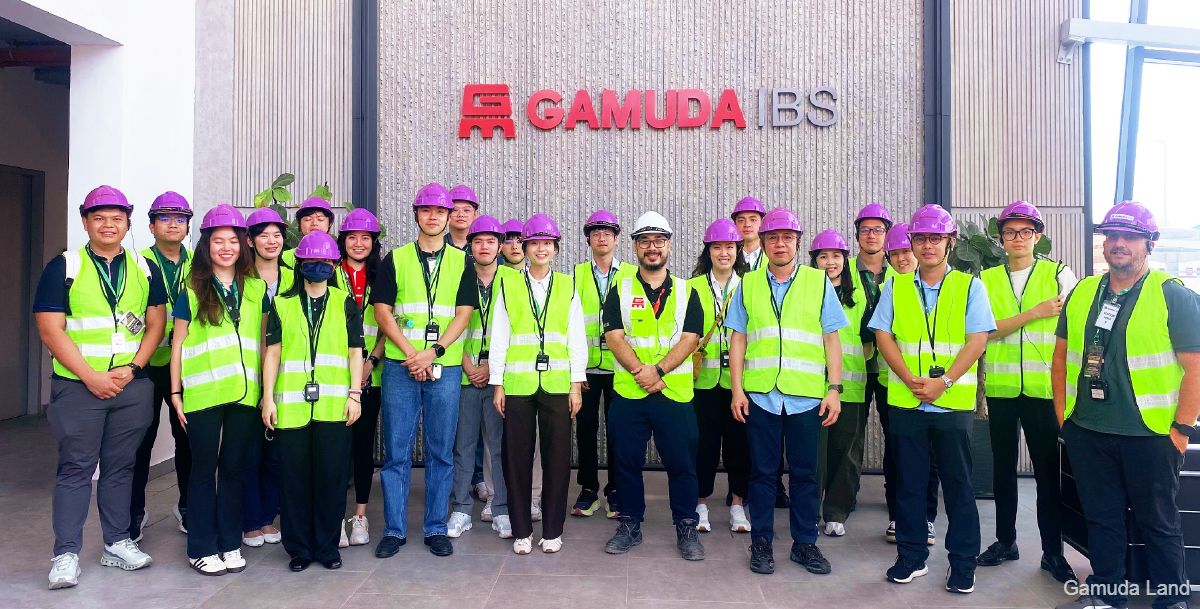
Rehda Youth’s latest Township Tour Series took participants through two aspects of modern property development — how a township is planned and activated, and how its homes are increasingly being built off-site. The Aug 28 visit to Gamuda Cove and Gamuda IBS Banting Factory — both in Selangor — gave participants a view of how integrating off-site digital construction with nature-led master planning creates faster, more sustainable and commercially viable smart townships, said organising chair Jane Low.
“These locations were chosen together to demonstrate the complete lifecycle of modern development, connecting off-site automated manufacturing at the digital IBS (industrialised building system) factory directly to its on-site application in a nature-led smart city, Gamuda Cove,” she explained.
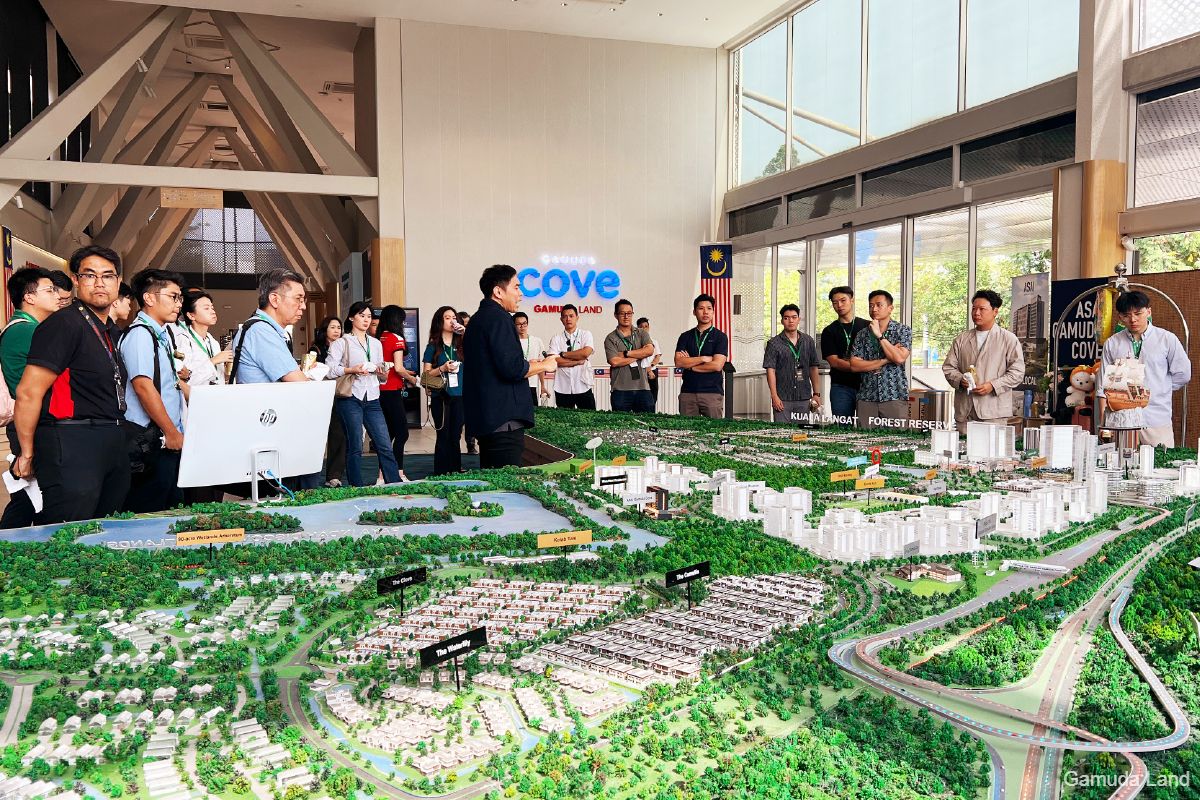
Low noted that Gamuda Cove serves as a living prototype for a low-carbon smart township built around a 15-minute city framework that integrates green infrastructure, such as the adjacent Paya Indah Discovery Wetlands, with modern mobility including electric trams (e-trams) and 5G connectivity.
“At Gamuda IBS Banting, construction is digitalised through 3D Building Information Modelling (BIM) design, robotic automation and prefabricated volumetric components. To date, Gamuda IBS has produced over 15,000 units for both Gamuda’s own developments and external clients,” she said.
Gamuda Cove is Gamuda Land’s flagship township project and the first development in Malaysia to receive a 5-diamond rating under the Low Carbon City 2030 (LCC2030) Challenge in the Design category from the Malaysian Green Technology and Climate Change Corporation.
Gamuda Cove
Presenting the township’s sustainability framework, Gamuda Land head of sustainability product management Leong Sai Pink said Gamuda Cove operates under the Low Carbon City Framework, targeting a 45% reduction in carbon emissions by 2030 against a business-as-usual baseline.
Leong said an internal carbon audit identified energy (48%) and urban transport (29%) as the primary drivers of township emissions, followed by waste (9%), building components (7%) and water (5%). Gamuda Land targets a 45% reduction across these categories by 2030 through mandated green building certifications for all developments within the township and by using its IBS construction methods.
To tackle energy consumption, residential units adopt passive design strategies, including optimised building orientations to minimise east-west solar gain, thermal insulation and cross-ventilation, alongside a minimum Green Building Index (GBI) or GreenRE Bronze certification.
Commercial assets incorporate active cooling, smart sensors, solar street lighting, a minimum solar photovoltaic installation across 30% of roof areas and a minimum GBI or GreenRE Silver certification.
For urban transport, the township prioritises non-motorised mobility and transit networks, with dedicated cycling paths, pedestrian walkways, bike stations and e-trams currently connecting key nodes such as SplashMania, Townsquare and The Hive.
Infrastructure support includes 30 electric vehicle (EV) charging points and Southeast Asia’s largest Tesla Supercharging hub.
Gamuda Cove also houses the Wetlands Arboretum — a living tree museum of more than 200 plant species that preserves 3,000 trees — located at the perimeter of the township.
Certified as Malaysia’s first zero-carbon-ready building under EDGE Advanced, a higher-tier green building certification under EDGE (Excellence in Design for Greater Efficiencies) by the International Finance Corporation (IFC), the Wetlands Arboretum runs on 100% off-grid solar power and uses natural materials such as bamboo and rammed earth, cutting embodied carbon by 40%.
Gamuda Land conducts biodiversity audits every five years to track post-development ecological recovery, supported by its advanced tree planting nurseries and the Miyawaki technique, which plants three trees per sq m for forest growth up to 10 times faster.
Future phases of the township’s e-tram will include 11 stops with three more trams as development within the town’s centre progresses.
Masterplan strategy
Gamuda Land chief operating officer (COO) Wong Siew Lee said the decision to develop Gamuda Cove rested on three factors: the scarcity of large pieces of land in the Klang Valley; the site’s setting next to natural wetlands; and its position along a major infrastructure spine in a growth corridor.
Township development gave the group long-term value and control over the asset, she said, while the existing nature linkage was difficult to replicate.
Wong said a township of Gamuda Cove’s size and location needed a strong identity from the outset, pointing to the pirate ship at SplashMania as a marker that passing drivers now recognise.
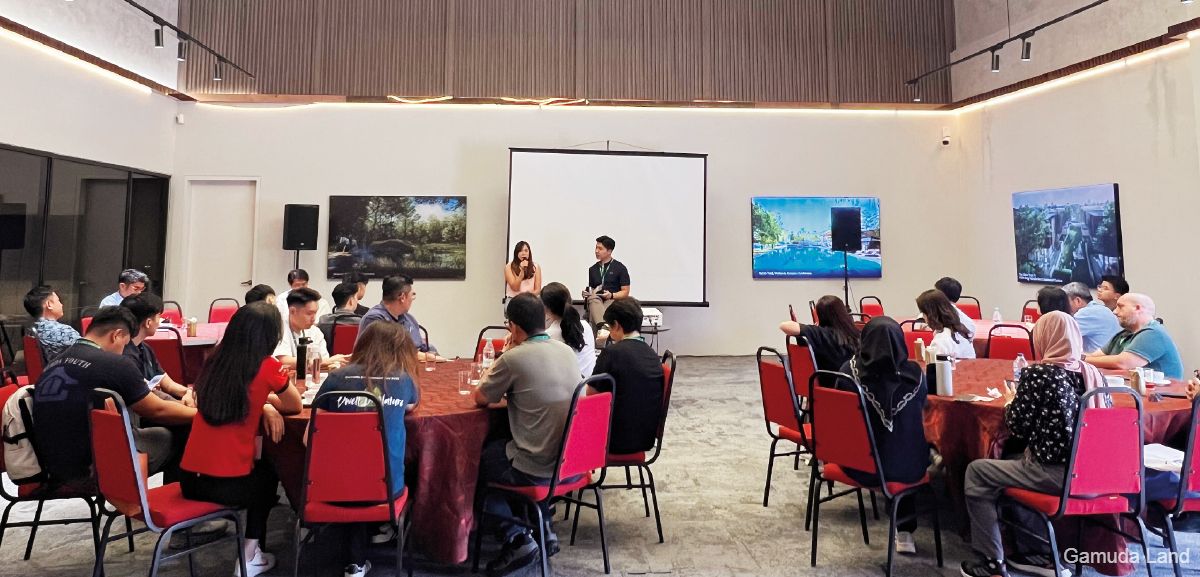
On the heavy capital expenditure behind early placemaking such as SplashMania, Discovery Park and the Paya Indah Discovery Wetlands, she said the group set out to break the “chicken-and-egg” problem between population growth and commercial activation.
“We wanted to accelerate maturity and push commercial diversity. That is why we created our placemaking components — SplashMania, the Wetlands and Discovery Park — as the first prong to kick-start the activation of this township,” Wong said.
She emphasises the priority of maintaining cash flow for the township’s initial launches to sustain it while the township is still in its infancy. “We have to ensure we have enough cash to sustain operations. It is a two-way effort.”
“By giving people a reason to travel here and get to know the area [through placemaking activators], we could then begin residential developments, followed by commercial developments to complement them.”
“This requires heavy capex. That is why we treat all these businesses separately; they are expected to break even on their own.”
Each placemaking asset is run as a separate business and is expected to self-sustain, she said, with minimal cross-subsidisation drawn from the township’s advertising and promotion (A&P) budget and cash recycled in phases as residential components are built and sold.
“This requires very strong cost and planning discipline in placemaking, so we do not overspend. We also partially monetise through our residential progress as we build it in stages,” Wong added.
Gamuda Cove aims to replicate the performance of Horizon Hills in Johor Bahru, the group’s township of more than 20 years, which Wong said generates a 20% to 30% profit margin on launches at this stage of its lifecycle.
Gamuda Cove is located near Shah Alam Expressway and South Klang Valley Expressway, with direct linkage to the ELITE (North-South Expressway Central Link) Highway interchanges.
Wong explained, “We needed to make the site regionally accessible because of the leisure components. That is why the first interchange connects directly to the ELITE Highway, linking us to KLIA, Putrajaya, Cyberjaya, Shah Alam and Petaling Jaya. That spine turns the township into a destination that supports tourism and draws out-of-town visitors.”
The second interchange, he said, is the 2km Bandar Gamuda Cove-Cyberjaya Interchange, which will connect to the ELITE Highway, giving Gamuda Cove residents direct access to Cyberjaya.
“The second [interchange will occur] as residential units and shops open, requiring sustainable daily footfall, providing socioeconomic sustainability so businesses can sustain themselves while waiting for the resident population to mature. This strategy ensures the township is resilient and not overly reliant on the investor market alone,” she explained.
Wong said the township was entering a later stage of activation, with offices due to open and negotiations under way to bring in a university and a hospital to complete its ecosystem.
Asked what she would refine about the township’s masterplan, Wong pointed to the green buffers formed by a mandatory 100m setback from the surrounding wetlands: the 100-acre Wetlands Park and the adjacent Central Park.
“If I could adjust one aspect, I would stage the delivery of Central Park. The park is quite expansive for the initial population, so staging it would not only manage capital outflow better, but bring the early community closer together. When amenities are spread out too early, it is harder to aggregate footfall,” she said.
Gamuda IBS Banting Factory
The last stop of the tour was Gamuda IBS Banting Factory, the 66-acre digital manufacturing facility that represents a near-RM500 million combined investment with the group’s Sepang plant.
Gamuda IBS senior manager Abang Ibrahim Abdul Rahman said the Banting facility takes the group’s total manufacturing capacity to 10,000 residential units a year. He highlights workforce transformation as the primary catalyst for Gamuda IBS.
“The most important thing about having a digital factory like ours is that we are bringing back our local workforce into the construction industry, thereby reducing our reliance on foreign labourers. Instead of having people at the site exposed to the elements, they work in a controlled environment where they can master specific roles.
“Conventional construction requires about 300 people doing structural work at a single site. Across four project sites, that’s 1,200 people. In this factory, we are producing four projects concurrently with only 120 people on the carousel line doing those structural elements. That is just 10% of the manpower,” Abang Ibrahim explained.
The factory runs on an end-to-end digital ecosystem, integrating 3D BIM design, cloud management, robotic manufacturing, digital logistics tracking via QR codes and on-site Lego-like assembly.
These processes deliver significant carbon savings, with reductions of 41% at the product stage — driven by 30% fly ash cement replacement and precise manufacturing and 53% at the construction stage, achieved through material wastage of under 1% and 40% faster delivery.
Gamuda IBS’ product range includes solid walls, double walls, half slabs, staircases and volumetric solutions such as prefabricated bathroom units (PBU), small compartment units (SCU) and prefabricated prefinished volumetric construction (PPVC).
Axial Design Architects Sdn Bhd (ADA) architect Axxu Hoi detailed the execution of IBS at Gamuda Cove’s Mori Pines (Phase 1D), a landed residential project that achieved an IBS score of 100. Mori Pines is Hoi’s first project with Gamuda Land.
“In terms of construction speed, Gamuda reports up to 50% to 60% faster times, taking transport and site logistics into account. You don’t have to wait for wet trades or concrete curing on site,” Hoi said.
Addressing common industry concerns about design rigidity, cost and waterproofing, he explained that digital IBS requires a fundamental shift in project planning. To guarantee watertightness, the factory casts an integrated concrete nib or upstand onto the wall panels during production, ensuring window frames sit on a solid concrete base rather than vulnerable brickwork joints.
“IBS requires design decisions up front. You cannot make last-minute structural changes once fabrication starts in the factory. Want to add an extra wall socket after production? You can’t. Therefore, the design process must be fully coordinated upfront,” Hoi noted.
On cost, he emphasised that economic viability does not depend on a high minimum order quantity for a single house type, but on dimensional standardisation. Uniform 1.5m by 2.4m bathroom footprints across different unit layouts, for instance, allow the exact same steel moulds to be reused across volume runs.
Hoi also addressed homeowner renovation concerns, explaining that Gamuda provides buyers with clear technical boundaries for future modifications. Rather than assuming all walls are load-bearing, Gamuda Land’s development team maps out non-structural partition walls and outlines permitted hacking zones using a dedicated homebuyer manual.
“An IBS home is a precision-engineered industrial product, much like a car, and should be accompanied by a comprehensive user manual,” Hoi said.
Article Link: https://theedgemalaysia.com/node/818539